Article: What Makes Corporate Gifts Feel Generic — and Forgettable
What Makes Corporate Gifts Feel Generic — and Forgettable
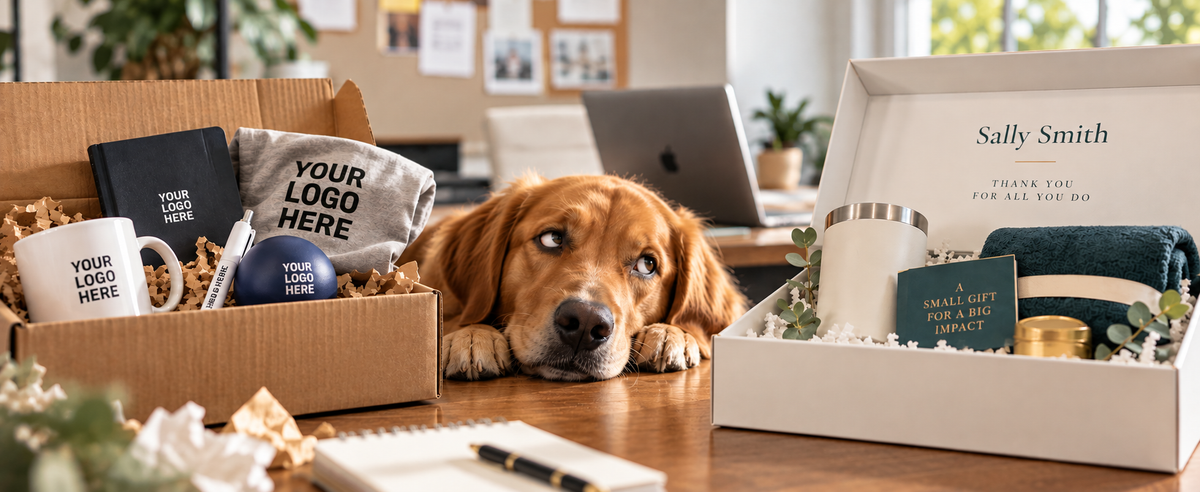
Every December, somewhere, a perfectly nice person opens a box from a vendor, finds a branded mug, a branded pen and a branded stress ball, and feels exactly nothing. The vendor spent real money. The recipient spent four seconds. Nobody is a villain here. The gift was just built to be sent, not to be remembered.
This post is about why that happens and what to change. It is not about spending more.
What causes corporate gifting campaigns to feel generic and forgettable?
Corporate gifts feel generic when the sender's logo is the hero, the items are things the recipient already owns, nobody chose the gift with this particular person in mind, and the packaging is an afterthought. Each of those is a decision, and each can be made differently.
The evidence for "forgettable" is not subtle. In a Business.com poll of 1,547 professionals (October 2022), 54 percent of those who receive corporate gifts said they have thrown away at least one gift without even using it. The same study says the gifts most often discarded were redundant everyday items — mugs, pens, keychains, magnets, t-shirts — and that logo-heavy swag came up again and again as unwanted.
Why does a big logo make a gift forgettable?
A gift with an oversized logo reads as advertising, and people treat advertising like advertising: they skim it and move on. The recipient is being asked to carry your brand around, not being thanked.
The fix is placement, not removal. Put the brand where it earns its keep — on the box, the inside of the lid, a card — and let the item itself be something the person would have bought for themselves. Brand recall does not need a billboard. The promotional products industry's own research (ASI, April 2026) reports that 85% of consumers remember the advertiser who gave them a promo product — so you can afford to whisper.
Why do "safe" gifts end up in a drawer?
Safe gifts are things the recipient already has, so they replace nothing and get used by no one. A third water bottle is not a gift; it is clutter with good intentions.
Usefulness is the thing that keeps an item out of the bin. ASI's same study reports that 78% keep items because they find them useful. (A fair caveat: ASI represents the promotional products industry, so read its numbers as industry research, not neutral research.) "Useful" means useful to this person — a golfer's tournament kit, a new parent's coffee upgrade, a remote team's actual desk setup — not useful in the abstract.
Is the gift too cheap, or just badly chosen?
Usually badly chosen, but expectations matter too. Business.com found that recipients expect vendors to spend $100 on each corporate gift, but the actual median expenditure is only $30. That gap explains a lot of disappointment.
You do not have to close it with money. A smaller gift with one excellent item, chosen for the person, beats a larger box of filler. If the budget is tight, cut the number of items before you cut their quality. (Our budget planner does that arithmetic for you.)
Does packaging really change how a gift is remembered?
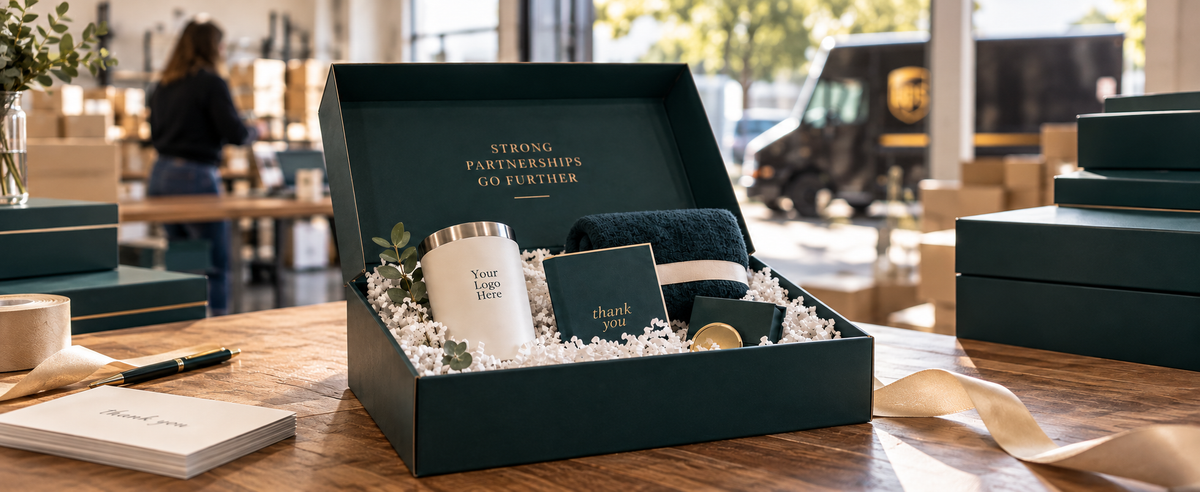
Yes — the box is the first thing the recipient touches and the part that says "someone thought about this" before anything is unwrapped. A plain shipper with crinkle paper tells them the gift was fulfilled. A rigid box with a reveal tells them it was given.
This is why we treat the box as part of the gift rather than its container: a one-piece magnetic soft-touch box, fully custom printed, with art inside the lid that the recipient sees the moment it opens. It is also the most reliable place for your brand to live without shouting.
Why do large campaigns feel more generic than small ones?
At scale, teams default to one SKU for everyone because personalization looks like an operations problem. It mostly is — which is why it gets dropped. We covered the operational side in 7 reasons corporate gifting campaigns fail at scale, and why fewer handoffs protect the experience in how end-to-end gifting campaigns improve client engagement.
The middle path is tiers and touches: two or three box variants by relationship, plus one personal element in every box (a name, a handwritten-style card, an item tied to something you know about them). That is achievable at 40 recipients or 4,000.
Generic vs. memorable: a quick comparison
| Decision | Generic version | Memorable version |
|---|---|---|
| Brand placement | Large logo on every item | Brand on the box, lid art and card; items stand on their own |
| Item choice | Mug, pen, tote "because everyone likes them" | One or two things this audience would buy for themselves |
| Tech | A power bank as the hero | Tech as a useful extra, never the centerpiece |
| Personalization | None, or a mail-merge first name | One real detail per recipient or tier |
| Packaging | Shipper box and crinkle paper | Custom-printed rigid box with a reveal |
| Message | "Happy Holidays from all of us at…" | A sentence that could only have been written to them |
| Timing | Lands in the December pile | Lands before the pile — or after, with a reason |
When a better gift won't help
An honest concession: a gift cannot fix a relationship that is going badly for a real reason. If a client is unhappy with your service, the most beautiful box in the world reads as a distraction, and sometimes as an insult. Fix the problem first. Gifts amplify goodwill; they do not create it from nothing.
And sometimes the generic gift is fine. A conference giveaway that 2,000 strangers will grab on the way past a booth does not need a lid reveal. Spend the thought where the relationship is.
How to make your next campaign memorable (a short checklist)
- Decide who it is for before deciding what it is.
- Move the logo off the hero item.
- Replace one filler item with one excellent one.
- Make the box part of the gift.
- Add one detail per recipient or tier.
- Check the calendar. For holiday 2026, BirdieBox's standard deadline is November 1 for all products, including custom-decorated programs, and the rush deadline is December 1 for in-stock products only (holiday deadlines). Exceptions can usually be accommodated, but may carry an additional fee.
If you would rather hand the whole thing off — sourcing, kitting, address collection, warehousing and shipping, with every box photo-verified before it leaves — start here. No minimums: one box or one thousand.
Frequently asked questions
What causes corporate gifting campaigns to feel generic and forgettable?
Logo-first items, things the recipient already owns, no personal element, and packaging that looks like shipping. Each is a choice that can be made differently.
How many corporate gifts get thrown away?
In a Business.com poll of 1,547 professionals (October 2022), 54 percent of corporate-gift recipients said they had thrown away at least one gift without using it.
Should corporate gifts have a logo on them?
Usually somewhere, rarely front and center. Put the brand on the box, inside the lid and on the card, and let the items stand on their own.
How much should a corporate gift cost?
Business.com found recipients expect about $100 per vendor gift while the median spend is $30. Fewer, better items close more of that gap than more items do.
Can a large campaign still feel personal?
Yes. Use two or three tiers by relationship and one personal detail in every box. That works at 40 recipients or 4,000.
What is the holiday 2026 ordering deadline at BirdieBox?
November 1 is the standard deadline for all products, including custom-decorated programs. December 1 is the rush deadline for in-stock products only. Exceptions can usually be accommodated but may carry an additional fee.